
DJI Osmo Pocket 4 Review: The Vlogging Camera Almost Perfected
The Osmo Pocket 4 moves to a 1-inch sensor, 4K at 120 fps, full 10-bit D-Log, and a smarter three-mic array. Here is why creators outside the US are calling it the only vlogging camera they need — and why US buyers have a problem.
O
omer-yld
April 21, 2026 · 8 min read
Review9/10
Overall Score
9
out of 10Image Quality
9.5
Gimbal Stabilization
9.5
Audio
9
AI Tracking
8.5
Form Factor
9
The Pocket 3 Was Already Great. The Pocket 4 Fixes What Was Left.
The DJI Osmo Pocket 3 earned a near-cult following among vloggers because it compressed a gimbal, a capable sensor, a flip-out screen, and decent onboard audio into something you could genuinely pocket. The DJI Osmo Pocket 4, revealed in April 2026, is the sequel creators have been publicly requesting since the moment Pocket 3 shipped. It keeps the form factor and adds the things people asked for: a better sensor, a true 4K 120 fps mode, full 10-bit D-Log, more reach in low light, and smarter audio.
There is one loud asterisk. DJI is not currently able to sell the Pocket 4 in the United States through its own channels, which means American buyers are importing it at roughly £445 (about $605) from international retailers. That dynamic shapes the entire conversation around this camera.
This review synthesizes long-form coverage from Engadget, DroneXL, The Gadgeteer, Amateur Photographer, and DJI's own specifications sheet. We have not shot a wedding with one; we have read the people who did.
Design and Handling: Still Genuinely Pocketable
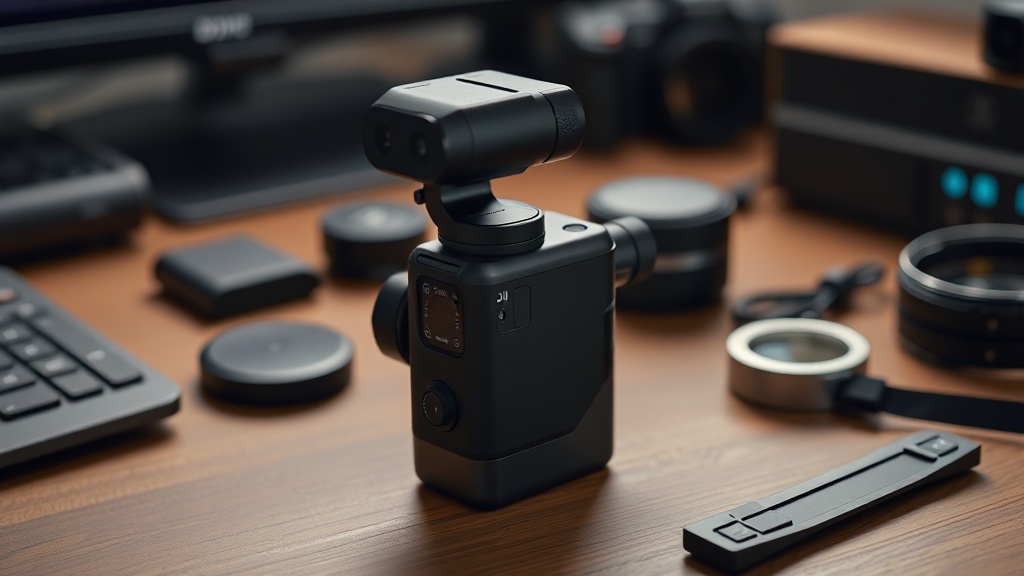
Physically, the Pocket 4 follows the Pocket 3 template. You get a vertical three-axis mechanical gimbal with the camera head sitting above a compact grip that houses the battery, controls, and a 2-inch touchscreen. Engadget's review notes the screen now ships alongside dedicated new buttons, which makes on-device mode switching faster than hunting through a nested menu.
The grip is still slim enough to vanish into a jacket pocket or a small sling bag. Crucially, the gimbal head still tilts into a vertical shooting orientation and the screen still rotates to match, which is the core reason TikTok and Reels-first creators pick this over a mirrorless camera. The tradeoff, as every reviewer notes, is that a mechanical gimbal in the open air cannot be sealed against dust or water — so the Pocket 4 has no real IP rating, and you should not use it in real weather.
Build quality is typical DJI: plastic-heavy but solid, with a premium feel where you touch it. The Creator Combo includes the handle extension, a carrying case, the DJI Mic 3 transmitter, and an ND filter set, which remains the combo worth paying up for if you are buying the camera as a working tool.
Image Quality: The 1-Inch Sensor Changes the Math
The headline hardware upgrade is the 1-inch CMOS sensor, carried over and tuned from the Pocket 3 direction with what DJI claims is two additional stops of low-light performance for a total of 14 stops of dynamic range. DroneXL's review and Engadget both call out the low-light gains as genuinely visible, not a spec-sheet line. Indoor ambient-light vlogs that looked soft and noisy on earlier Pocket generations now sit at clean, gradeable ISO levels.
Video tops out at 4K at 120 fps, up from 4K 120 on the Pocket 3 but with more usable rolling shutter behavior per Engadget's testing, and 1080p is available at higher frame rates for slow motion. The shutter speed now reaches as slow as 1/4 second for deliberate blur effects — a small but telling addition for creators who want a cinematic feel at night.
The other major upgrade is full 10-bit D-Log, replacing the D-Log M profile on the Pocket 3. D-Log M was an "easy-grade" log profile aimed at beginners; full D-Log gives colorists the headroom they expect from DJI's larger cinema cameras, which means Pocket 4 footage can be dropped on a timeline next to a Ronin 4D or Inspire 3 without a color discontinuity. That is a meaningful workflow upgrade for multi-camera creators.
Lossless 2x zoom and a 4x zoom at 1080p extend framing options without the typical digital-zoom degradation. Portrait-mode video is capped at 3K resolution, which is the one spec limitation we would call out — most reviewers do.
Gimbal and Stabilization: Still the Reason to Buy
Mechanical three-axis gimbal stabilization remains the Pocket 4's defining advantage over any digital-stabilization competitor, including the GoPro Hero 13 and Insta360 Go 3S. Walking footage is genuinely smooth without resorting to heavy electronic cropping or post-production warp. Running footage still shows the limits of any mechanical system, but the result is closer to a Ronin handheld than to a GoPro HyperSmooth clip.
DJI's ActiveTrack continues to be the best subject-locking system in this form factor. In Engadget's review, ActiveTrack stays on a moving subject through moderate occlusion and returns quickly after frame re-entry. Combined with the rotating screen, a solo creator can set the camera on a tripod, walk into the frame, and trust the gimbal to follow them — the Pocket 4 is, in that specific sense, better at being a content-creation tool than most full-size mirrorless cameras.
Audio: Three Mics and DJI Mic 3 Integration
Audio was a clear Pocket 3 weakness once you moved beyond a quiet room. The Pocket 4 addresses that with a three-microphone array supporting spatial audio capture, Vocal Boost, and an "audio zoom" feature that pulls voices forward when you zoom in on a subject. Engadget's testing described the onboard audio as genuinely usable for solo on-camera work in moderately noisy environments — a step change over Pocket 3.
For serious work, the Creator Combo's DJI Mic 3 transmitter pairs directly with the Pocket 4 and delivers wireless lavalier-grade audio without an external receiver. That combination — a 1-inch-sensor 4K camera and a pro-grade wireless mic, all in a jacket pocket — is the product story.
Battery, Storage, and Everyday Use
The 1,545 mAh internal cell delivers roughly 2.5 hours of continuous 4K recording, per DJI's specifications and Engadget's testing. That is a real-world improvement over the Pocket 3 for long-form content. USB-C fast charging tops the camera up during a coffee break.
Storage is a real quality-of-life upgrade. The Pocket 4 includes 107 GB of onboard storage and a microSD slot for expansion. Serious creators can still drop in a fast V60 or V90 card; casual users may never need to. This is the first Pocket that can realistically survive a day of shooting without a card swap.
How Long Does the DJI Osmo Pocket 4 Battery Last?
The DJI Osmo Pocket 4 uses a 1,545 mAh internal battery that delivers approximately 2.5 hours of continuous 4K video recording on a single charge, per DJI's specifications and Engadget's testing. Lower resolutions and frame rates stretch runtime further. The camera charges over USB-C, and the Creator Combo adds a battery handle that roughly doubles total shooting time.
DJI Osmo Pocket 4 vs GoPro Hero 13
The GoPro Hero 13 is the most readily available US alternative for creators who cannot or will not import the Pocket 4. They are different products solving overlapping problems.
Image quality favors the Pocket 4 meaningfully. A 1-inch sensor with two stops more low-light performance than the Pocket 3 is in a different class from the Hero 13's smaller action-camera sensor, particularly indoors and at dusk.
Stabilization is a philosophical split. The Pocket 4 uses a true three-axis mechanical gimbal, so stabilized footage retains the full sensor frame and looks cinematically smooth. GoPro's HyperSmooth is the best digital stabilization in the business but still crops and still warps under fast panning.
Durability is a decisive GoPro win. The Hero 13 is waterproof to 10 meters, drop-rated, and field-replaceable. The Pocket 4's gimbal architecture means it effectively cannot be weather-sealed.
Audio favors the Pocket 4 with its three-mic array plus DJI Mic 3 ecosystem. GoPro's built-in audio has improved but is still a link-in-chain rather than a hero feature.
Availability and price favor GoPro in the United States. The Hero 13 is a straightforward domestic purchase; the Pocket 4 requires imports at European pricing.
If you shoot talking-head vlogs, studio B-roll, solo interviews, or cinematic walk-and-talks, the Pocket 4 is the better camera. If you shoot surfing, mountain biking, ski days, or anything that could get submerged or dropped, the Hero 13 is the better camera.
For creators building a broader kit, see our Insta360 Link 2 Pro webcam review and our guide to point-and-shoot film cameras.
Who Should Buy the DJI Osmo Pocket 4
Full-time vloggers and short-form content creators outside the United States are the clearest buyers. The Pocket 4 is, for the first time, a credible primary camera rather than a capable B-cam. The 1-inch sensor, 10-bit D-Log, and DJI Mic 3 audio chain can carry a professional workflow.
Multi-cam creators using DJI's cinema ecosystem should upgrade for the D-Log parity alone. Grading a Pocket 4 clip next to Ronin or Inspire footage is now a one-lookup-table job.
Pocket 3 owners with no workflow complaints can wait. The upgrade is real but incremental if you are not hitting Pocket 3 limits today.
US-based buyers should think carefully. The Pocket 4 is the better vlogging camera on technical merits, but the import premium, warranty uncertainty, and replacement logistics matter in a working tool. If those friction points are dealbreakers, the GoPro Hero 13 or a compact mirrorless like a Sony ZV-E10 II is a saner domestic choice.
The Verdict
The DJI Osmo Pocket 4 is the vlogging camera the Pocket line was always trying to become. The 1-inch sensor finally delivers the low-light headroom creators needed, 4K 120 fps opens up slow-motion B-roll without a second body, and full 10-bit D-Log erases the grading compromise that held Pocket 3 back in professional workflows. The three-mic array plus DJI Mic 3 combo may be the best small-form-factor audio package on the market.
The availability picture in the United States is a genuine problem that DJI cannot solve on its own, and the gimbal design will never be waterproof. If those tradeoffs work for your shoots, the Pocket 4 is one of the most joyful creator tools we have read about this year.
What We Liked
- Upgraded 1-inch CMOS with two extra stops of low-light performance
- 4K video up to 120 fps plus 2x lossless zoom
- Full 10-bit D-Log replaces D-Log M for serious color grading
- Three onboard microphones with spatial audio and Vocal Boost
- ~2.5 hours of 4K recording on a 1,545 mAh cell
- Built-in 107 GB storage plus microSD expansion
What Could Improve
- No official US distribution — buyers must import
- Portrait-mode video capped at 3K resolution
- Gimbal design prevents any meaningful dust or water rating
The Verdict
The DJI Osmo Pocket 4 is the most complete pocket vlogging camera DJI has ever built. The 1-inch sensor, 4K 120 fps capture, proper 10-bit D-Log, and smarter three-mic array finally deliver the image and audio package that creators have been asking for since the original Osmo Pocket. The caveat is the elephant in the room: DJI's current US situation means Americans have to import one at European prices. If you can, do. If you cannot, the GoPro Hero 13 is the closest domestic substitute, though it cannot match the Pocket 4's low-light image quality or mechanical stabilization.
Was this article helpful?
Join the conversation — sign in to leave a comment and engage with other readers.
Loading comments...
Related Posts
photography
Sony at NAB 2026: R Series Cameras, XYN Spatial Tools, AI Workflows
Apr 21, 2026wearables
Apple Watch Ultra 3 Review: The Adventure Watch Catches Up to Garmin
Apr 21, 2026software-tools
Logitech MX Master 4 Review: The Productivity Mouse Reinvented With Haptics
Apr 20, 2026software-tools
Kindle Scribe (2025) Review: Amazon's Best E-Reader and Note-Taker Gets a Major Overhaul
Apr 20, 2026Enjoyed this article?
Get the best tech reviews, deals, and deep dives delivered to your inbox every week.