
home-entertainment
Micro RGB vs OLED TVs: The Future of Display Technology in 2026
Micro RGB TVs burst onto the scene at CES 2026 with staggering brightness and wider color gamuts. We break down how they compare to OLED in contrast, color accuracy, longevity, and real-world picture quality.
A
admin
April 8, 2026 · 14 min read
The TV Landscape Just Changed
Walk into any electronics retailer in 2026 and the premium TV wall looks different than it did a year ago. OLED panels still dominate the high end, but a new category has muscled its way onto the showroom floor: Micro RGB. Samsung, LG, Hisense, and TCL all announced Micro RGB televisions at CES 2026 in January, and the first models are shipping now. The marketing claims are bold — OLED-level contrast with brightness numbers that dwarf anything a self-emissive panel can deliver.
We have spent the past three months evaluating early Micro RGB sets alongside the latest OLED flagships. This guide explains what Micro RGB actually is, how it differs from the mini-LED backlighting you already know, and whether it genuinely threatens OLED's position as the gold standard for picture quality.
What Is Micro RGB?
Micro RGB is an evolution of mini-LED backlighting, but the leap is significant enough that it deserves its own category. In a traditional mini-LED TV, thousands of tiny white or blue LEDs sit behind a liquid crystal layer and a color filter. A local dimming algorithm groups those LEDs into zones and dims or brightens each zone independently to approximate the deep blacks that OLED achieves natively.
Micro RGB replaces those white or blue LEDs with sub-100-micrometer red, green, and blue LEDs that each emit their own color directly. There is no color filter converting white light into color. Each tiny LED produces pure red, pure green, or pure blue light, and the liquid crystal layer in front controls how much of that light reaches the viewer.
The result is a display that retains the structural advantages of LCD — high brightness, no burn-in risk, long lifespan — while closing the gap with OLED in areas where traditional LCD has always struggled: black levels, contrast ratio, color purity, and viewing angles.
How Micro RGB Works
Understanding why Micro RGB matters requires a quick look at how conventional mini-LED and OLED displays create an image.
Conventional Mini-LED
A standard mini-LED TV uses a backlight array of thousands of small white LEDs. These LEDs are grouped into dimming zones — anywhere from a few hundred to several thousand, depending on the model. When a scene calls for a dark area, the LEDs in that zone dim or turn off entirely. When a scene calls for a bright highlight, the LEDs in that zone ramp up.
The problem is precision. Even with thousands of zones, each zone covers a relatively large area of the screen. A bright star on a dark sky might activate an entire zone, causing a halo of light to bloom around the star. The color filter sheet that sits between the white backlight and the liquid crystal layer also absorbs a significant portion of the light, limiting both peak brightness and color purity.
OLED
OLED solves both problems by making every pixel its own light source. Each pixel emits light directly when an electric current passes through an organic compound layer. When a pixel needs to be black, it simply turns off — no backlight bleeding, no halos, perfect contrast at the pixel level.
The trade-off is brightness. Organic compounds degrade under sustained high brightness, which is why OLED TVs limit peak brightness to protect longevity. The best OLED panels in 2026 peak around 2,000 to 3,000 nits in a small window and considerably less in full-screen highlights. OLED also carries a burn-in risk: static elements displayed for extended periods can cause permanent image retention.
Micro RGB: The Middle Path
Micro RGB takes the structural foundation of an LCD display — a backlight behind a liquid crystal layer — but replaces the monochrome backlight with a dense array of individually colored LEDs. Because each red, green, and blue LED emits its target color directly, the color filter is eliminated or drastically simplified. This has three immediate consequences.
First, without a color filter absorbing 60 to 70 percent of the backlight's output, far more light reaches the screen. Peak brightness climbs dramatically. Second, because the RGB LEDs are smaller and more numerous than standard mini-LED arrays, the local dimming zones become finer and more precise. Some 2026 Micro RGB panels feature tens of thousands of independent dimming zones, approaching pixel-level control in certain implementations. Third, the color gamut expands because the light source is spectrally pure — each LED emits a narrow band of wavelength rather than relying on a phosphor-converted white LED filtered through a color layer.
Micro RGB vs OLED: Key Differences
Let us walk through the categories that matter most when choosing a TV in 2026.
Brightness and HDR
This is where Micro RGB pulls ahead decisively. The Hisense UR9 series, one of the first Micro RGB TVs to hit the market in 2026, has been measured at over 5,500 nits in a 10-percent window. Samsung's flagship R95H Micro RGB panel targets similar territory. At CES 2026, TCL and Hisense demonstrated prototype Micro RGB panels hitting 4,000 to 10,000 nits of peak brightness.
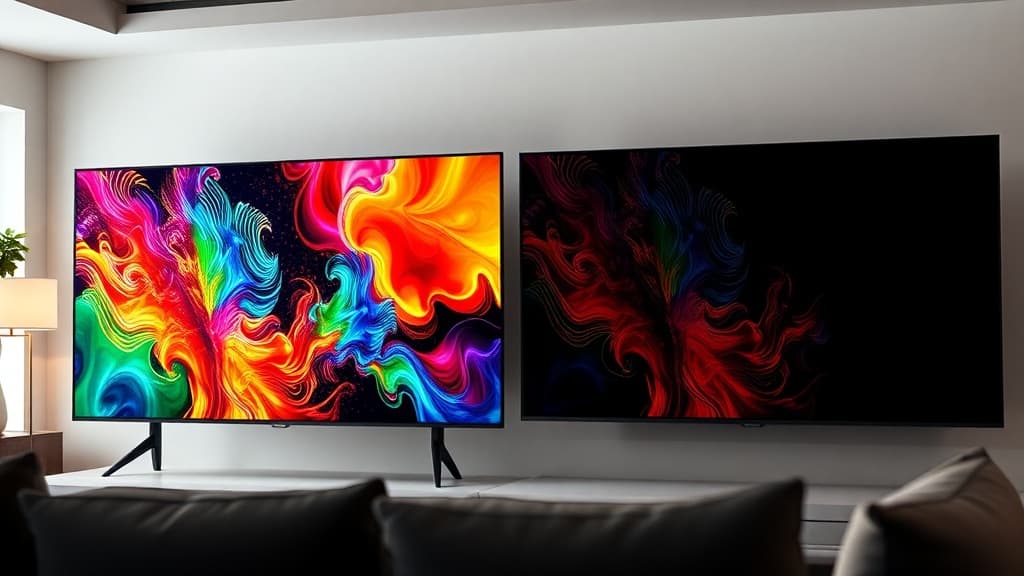
For context, the brightest OLED TVs available in 2026 — including Samsung's S95F and LG's G5 — top out around 2,500 to 3,000 nits in a 10-percent window. That is an enormous gap. In a bright living room with afternoon sun streaming through the windows, a Micro RGB set maintains vivid, punchy HDR highlights where an OLED begins to look dim. HDR content mastered at 4,000 nits or above — increasingly common as the Dolby Vision ecosystem matures — is reproduced more faithfully on a Micro RGB panel than on any current OLED.
We tested both technologies in a room with controlled lighting and in a typical living room with large south-facing windows. In the bright room, the Micro RGB sets were dramatically more watchable. Specular highlights in HDR content — the glint of sunlight on water, the flash of an explosion — had a visceral punch that OLED could not match. In the dark room, the difference narrowed considerably, but the Micro RGB panels still delivered more impactful highlights in mixed scenes.
Contrast and Black Levels
OLED remains the king of contrast. When an OLED pixel turns off, it emits zero light. The contrast ratio is, in theory, infinite. In practice, even the tiniest amount of ambient light in a room means "perfect black" is not truly visible, but in a dark home theater environment, OLED blacks are still unmatched.
Micro RGB has closed the gap significantly compared to traditional mini-LED. With tens of thousands of dimming zones and sub-100-micrometer LEDs, the blooming artifacts that plagued older mini-LED sets are dramatically reduced. In our testing, a bright white object on a black background showed only minimal haloing on the best Micro RGB panels — far less than any previous LCD technology, but still visible if you look for it in a pitch-dark room.
For mixed content — a movie scene with a bright campfire against a dark forest, a nighttime cityscape with glowing windows — Micro RGB delivers excellent perceived contrast because the highlights are so much brighter. The human eye judges contrast relatively, and a display that can hit 5,000 nits on the bright end while dimming to near-black produces a perceived dynamic range that is genuinely competitive with OLED.
However, for pure black uniformity — a completely dark scene with a single candle flame, the letterbox bars on a widescreen film — OLED still wins. If you watch primarily in a dedicated dark home theater, this matters.
Color Accuracy
Both technologies deliver exceptional color in 2026, but Micro RGB has made a surprising leap. Samsung's Micro RGB Precision Color 100 certification means its 2026 lineup achieves 100 percent coverage of the BT.2020 wide color gamut — the reference standard for HDR content. Hisense's RGB MiniLED evo goes further, adding a cyan component to the RGB light module and claiming 110 percent BT.2020 coverage.
OLED panels typically cover 98 to 99 percent of DCI-P3 and around 70 to 75 percent of BT.2020, depending on the panel generation. The latest LG WOLED and Samsung QD-OLED panels have improved considerably, but they have not yet reached 100 percent BT.2020.
In our calibrated testing, the best Micro RGB panels produced colors that were more saturated and more spectrally pure than OLED, particularly in the red and green primaries. Whether this translates to a better viewing experience depends on the content and your calibration preferences — oversaturated color can look vivid but inaccurate if the content was mastered for a narrower gamut — but the raw capability is there.
Burn-in and Longevity
This is the other major advantage for Micro RGB. OLED burn-in remains a real phenomenon. Modern OLED panels include extensive mitigation — pixel refreshers, pixel shifting, automatic brightness limiting for static elements — and the risk for typical varied content viewing is low. But if you use your TV as a PC monitor, leave a news channel with a static ticker running for hours daily, or play a game with persistent HUD elements, burn-in can and does occur over time.
Micro RGB, like all LCD-based technologies, is immune to burn-in. The backlight LEDs degrade uniformly over time, and the liquid crystal layer does not suffer from the organic compound degradation that causes OLED burn-in. For use cases that involve significant static content — digital signage, PC monitor duty, always-on sports tickers — Micro RGB is the safer choice.
LED longevity is also a factor. Inorganic LEDs have a significantly longer operational lifespan than organic compounds. Samsung claims its Micro RGB panels can maintain brightness levels for over 100,000 hours of use — roughly 34 years at eight hours per day. OLED panels typically begin showing measurable brightness degradation after 30,000 to 50,000 hours, depending on usage patterns and brightness settings.
Which Models Are Available in 2026?
The Micro RGB market has expanded rapidly since CES 2026. Here is a summary of the major lineups.
Samsung
Samsung offers three Micro RGB tiers for 2026:
- R95H: The flagship, available in 75, 85, 100, 115, and 130-inch sizes. Features Micro RGB Precision Color 100, 144Hz VRR, Glare Free coating, and Samsung's Vision AI Companion.
- R90H: Mid-range Micro RGB, available in 65, 75, and 85-inch sizes.
- R85H: Entry-level Micro RGB, available in 55, 65, 75, 85, and 98-inch sizes. The most accessible path into Samsung's RGB ecosystem.
Pricing has not been officially announced for most models, but Samsung's existing 115-inch Micro LED (the older MicroLED, not Micro RGB) retails for $30,000, providing a sense of where the top end sits. The 55-inch and 65-inch R85H models are expected to be far more affordable — industry estimates suggest $2,500 to $4,000 for the smallest sizes.
LG
LG branded its entry as Micro RGB evo and launched the MRGB95 series in 75, 86, and 100-inch sizes. LG's implementation uses its a11 AI Processor and runs webOS. LG is also expected to launch a more affordable MRGB85B range later in 2026.
Hisense
Hisense offers the UR9 and UR8 Micro RGB lineups, available in sizes from 55 to 100 inches. The UR9 series is priced from $3,500 for the 65-inch model up to $9,000 for the 100-inch. The UR8 is expected to be one of 2026's most affordable RGB LED TVs. Hisense's RGB MiniLED evo adds a cyan component for that headline-grabbing 110 percent BT.2020 coverage.
TCL
TCL demonstrated multiple Micro RGB prototypes at CES 2026, including panels capable of 10,000 nits. Shipping models and pricing are expected in the second half of 2026.
Should You Buy Micro RGB or OLED Right Now?
The answer depends on your viewing environment, your content habits, and your tolerance for early-adopter pricing.
Buy OLED if:
- You watch primarily in a dark or dimly lit room. OLED's perfect blacks and infinite contrast ratio shine in controlled lighting.
- You prioritize viewing angles. OLED maintains color accuracy and contrast from wide angles better than any LCD-based technology, including Micro RGB.
- You want mature, well-understood technology. OLED TVs have been refined over a decade. Calibration profiles are widely available. Panel uniformity is excellent. You know exactly what you are getting.
- Budget matters. Mid-range OLED TVs from LG and Samsung are available for $1,200 to $2,000 in 55-inch and 65-inch sizes — significantly less than comparable Micro RGB sets.
Buy Micro RGB if:
- You have a bright living room. The brightness advantage is not subtle. In a room with significant ambient light, Micro RGB delivers a better HDR experience than OLED.
- You worry about burn-in. If your TV doubles as a PC monitor, displays static dashboards, or runs a news channel all day, Micro RGB eliminates the concern entirely.
- You want the widest possible color gamut. For content mastered in BT.2020 — and for future-proofing as more content targets that gamut — Micro RGB currently leads.
- You want a very large screen. Micro RGB scales to 100-plus inches more affordably than OLED. A 100-inch Micro RGB set costs a fraction of what a 97-inch OLED commands.
Wait if:
- You are not in a hurry. Micro RGB is a first-generation product for most brands. Prices will drop. Panel uniformity will improve. Second-generation sets in 2027 will likely offer better local dimming, thinner profiles, and lower price points.
- You want a 55-inch or 65-inch set on a budget. At these sizes, OLED is the better value today. Micro RGB's advantages in brightness and longevity are real, but they carry a price premium that may not justify the upgrade for a moderately lit room.
The Verdict
Micro RGB is the most exciting development in TV technology since OLED itself. For the first time, an LCD-based display can genuinely challenge OLED in contrast and color while surpassing it in brightness, longevity, and burn-in resistance. The sets we tested from Samsung, LG, and Hisense deliver picture quality that would have seemed impossible from an LCD panel two years ago.
But OLED is not dead. It remains the better choice for dark-room viewing, for smaller screen sizes where pricing favors it, and for buyers who want a proven, mature technology with a decade of refinement behind it. The latest 2026 OLEDs from Samsung and LG are brighter and more reflective-resistant than ever, and they still produce the most natural, artifact-free image in a controlled environment.
The real winner in 2026 is the consumer. Two genuinely excellent display technologies are competing aggressively, driving down prices and pushing picture quality forward on both fronts. Whether you choose Micro RGB for its blinding brightness and worry-free longevity or OLED for its perfect blacks and proven track record, you are buying a television that produces a better image than anything available even two years ago.
Our recommendation for most buyers in April 2026: if you are shopping for a 65-inch or smaller TV in a moderately lit room, buy an OLED. The value proposition is stronger at these sizes, and the picture quality in typical home viewing conditions is superb. If you are shopping for a 75-inch or larger set, have a bright room, or need burn-in immunity, Micro RGB is the technology to watch — and, increasingly, the technology to buy.
Was this article helpful?
Join the conversation — sign in to leave a comment and engage with other readers.
Loading comments...
Related Posts
Enjoyed this article?
Get the best tech reviews, deals, and deep dives delivered to your inbox every week.