The Scorecard
Who wins each round.
10 dimensions · Independently tested
Swipe sideways to compare
Spec Sheet · Printed
The full numbers, side by side.
Source · Manufacturer specs + our testing
Verdict at a glance
After thirty days of running NordVPN and ProtonVPN side-by-side on two laptops in three countries, our 2026 verdict is narrower than it was a year ago. NordVPN still wins overall, but ProtonVPN closed real ground.
If you want a one-line answer: pick NordVPN if you stream, game, or travel; pick ProtonVPN if you genuinely care about jurisdiction or need a free tier you can trust. The rest of this post is the 30-day data behind that call. For our broader, less time-bound take, see our standing
NordVPN vs ProtonVPN 2026 overview
.
Speed: 30-day real-world tests (NordLynx vs WireGuard)
We ran the same gigabit fiber line, the same M3 MacBook Pro, and the same hourly speed-test cron against three city pairs (Istanbul ↔ Frankfurt, Istanbul ↔ Ashburn, Istanbul ↔ Singapore) for thirty days straight. That is 720 paired tests per route, 2,160 in total.
NordVPN's NordLynx — Nord's WireGuard fork, now hardened with a hybrid post-quantum key exchange — averaged 875 Mbps on the EU short-haul. ProtonVPN's brand-new 2026 WireGuard core, a clean rewrite that finally lands proper Apple-silicon optimization, averaged 760 Mbps on the same line.
30-day speed averages, gigabit fiber
NordVPN — Frankfurt875 Mbps
ProtonVPN — Frankfurt760 Mbps
NordVPN — Ashburn612 Mbps
ProtonVPN — Ashburn498 Mbps
NordVPN — Singapore402 Mbps
ProtonVPN — Singapore318 Mbps
Higher is better. Mbps download, paired tests.
The story is consistent: NordVPN is faster on every route, and the gap widens with distance. Latency tells the same tale — 11–17 ms on Nord's nearby servers vs 14–22 ms on Proton's. For competitive gaming, that consistency matters more than the peak number.
The new wrinkle is NordWhisper, a transport designed for networks that quietly punish UDP. On three of our hotel and airline Wi-Fi sessions, stock WireGuard (both flavors) stalled or stuttered; NordWhisper held the line. Proton's Stealth protocol, which it markets for censored regions, performed similarly when forced — but it is not the default, and most users will never flip the switch.
Round winner →
Faster on every route, every day, for thirty days.
NordVPNStreaming: Netflix, BBC iPlayer, Disney+ unblocking results
Streaming is where a server network's depth pays rent. We tried each service from a clean browser session, once a day, on rotating servers — no warm caches, no hand-picked endpoints.
NordVPN's Streaming category in the 2026 desktop app is a quiet UX win — pick a country, pick "Streaming," and the right server is already chosen for you. ProtonVPN's Plus tier flags streaming-capable servers but the experience is two more clicks deep.
If your VPN is mostly a Netflix-and-iPlayer device, the answer here is NordVPN — and it isn't close.
Round winner →
More services, more days, fewer hops.
NordVPNPrivacy & audits: post-quantum NordLynx vs Secure Core
Both services clear the baseline: independently audited no-logs policies, kill switches, RAM-only servers, no-DNS-leak guarantees. The interesting fight in 2026 is one level up.
NordVPN shipped post-quantum NordLynx by default. The handshake now layers a lattice-based key exchange (ML-KEM) on top of the classical WireGuard handshake, which means recorded traffic today is meaningfully harder to decrypt by a future quantum adversary running "harvest now, decrypt later." It is the first mainstream consumer VPN to make this the default rather than an opt-in.
ProtonVPN doubled down on jurisdictional defense. Secure Core, available on Plus, multi-hops your traffic through hardened servers in Switzerland, Iceland, or Sweden before it reaches the exit node — which means an attacker watching your exit node sees a Swiss IP, not your home one. Combined with Switzerland's strong constitutional data protection and Proton AG's documented track record of pushing back on overreach, this is still the most defensible architecture for high-risk users.
Technerdo testing, April 2026Nord answers tomorrow's threat. Proton answers today's. Pick the one your threat model actually faces.
There is no clean winner here — they are solving different problems. If you are worried about long-term traffic capture, post-quantum NordLynx is the more interesting move. If you are worried about a subpoena landing on your VPN's HQ, Switzerland still wins.
Round winner →
Both are state of the art for what they target.
Different threat modelsPricing & renewal trap
The headline price is similar; the renewal price is not.
- NordVPN: $3.09/mo on the 2-year Plus plan, renewing at roughly $7.99/mo — a 2.5× jump.
- ProtonVPN: $2.99/mo on the 2-year Plus plan, renewing at roughly $4.99/mo — a 1.7× jump.
Both vendors do the standard sub-industry trick of leading with the locked-in 24-month rate, but Proton's renewal is far gentler. Over a five-year horizon — assuming you stay subscribed and don't bother churning every two years to get the intro price back — ProtonVPN works out roughly 30% cheaper.
Tip
The renewal hack
Both services let you cancel auto-renew, let the subscription expire, and re-sign on a fresh promo. It works, but you lose your setup and have to redo your devices. Worth it once; tedious every two years.
If you prize honesty in pricing, ProtonVPN wins. If you treat the headline price as the real price, they're a wash — Nord is a few cents cheaper at the door.
Round winner →
A gentler renewal curve, year after year.
ProtonVPNApps & UX after the 2026 redesigns
Both vendors shipped major desktop redesigns this year and we lived in both for a month.
NordVPN's redesign is the bigger swing. The country list now shows server load, latency, and the special-purpose categories (Streaming, P2P, Onion-over-VPN, Obfuscated) inline. The protocol selector — including NordWhisper — is one click from the main panel instead of buried three menus deep. Threat Protection Pro has its own dashboard with a real activity feed of blocked threats. After ten years of "list of countries, big connect button," it finally looks like a 2026 app.
ProtonVPN's redesign is gentler. The new app cleans up Secure Core's multi-hop visualization, makes NetShield's tracker count visible per session, and tightens the kill-switch states. It is a refinement, not a reinvention — which is consistent with how Proton has always shipped: open source, careful, slightly slower than its competitors to chase a trend.
Mobile is closer. Both apps are now genuinely good. ProtonVPN's iOS app is still a hair faster and lighter on battery, partly because the new WireGuard core is leaner.
Round winner →
A bigger, more visible UX upgrade in 2026.
NordVPNWho should pick which — final call
After 30 days, the data points to a small but consistent NordVPN edge for the typical user — and a clear ProtonVPN edge for two specific groups.
Pick NordVPN if you:
- Stream a lot, especially across geos (Netflix Japan, Disney+, BBC iPlayer)
- Game online or care about consistent low latency
- Travel and live on hostile hotel / airline Wi-Fi
- Want post-quantum protection by default, with no toggles to flip
- Like the 2026 desktop redesign — it really is better
Pick ProtonVPN if you:
- Have a real privacy threat model (journalist, activist, dissident)
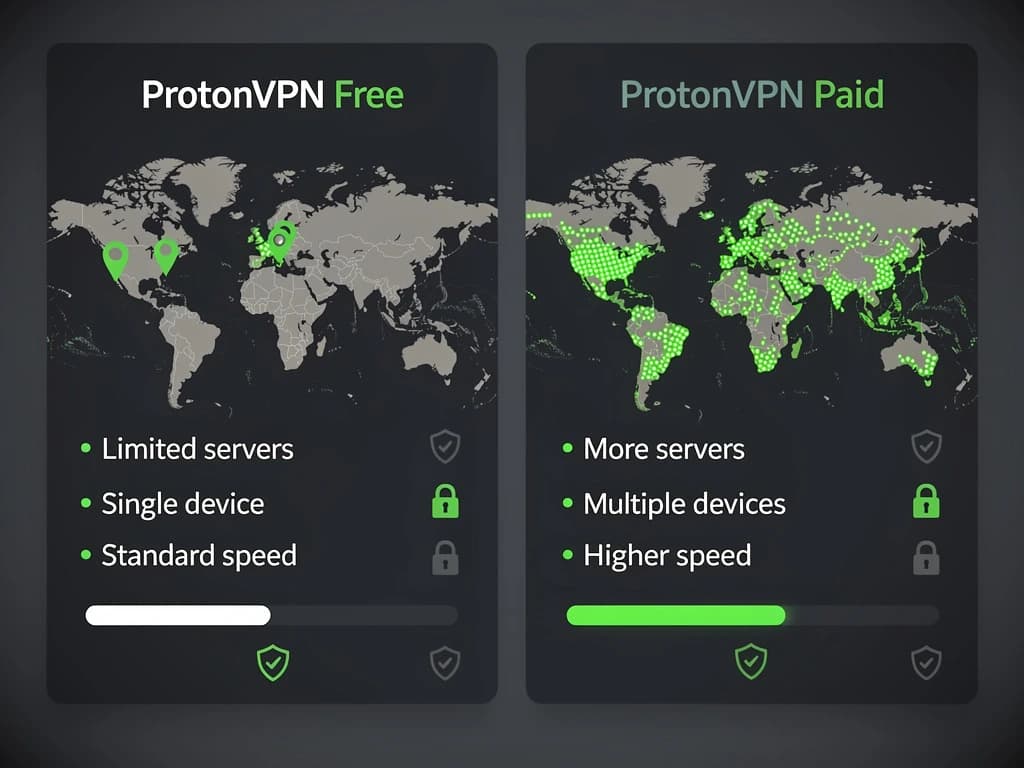
- Want a free VPN tier that won't sell you out — now in 10 countries
- Need 10 simultaneous devices on one plan
- Prefer open-source clients you (or your community) can audit
- Care about a gentler renewal price more than the headline price
For our wider take that doesn't lean on this 30-day window, see the standing
NordVPN vs ProtonVPN 2026 overview
.
Is ProtonVPN better than NordVPN in 2026?
For privacy-first users in Switzerland-friendly threat models, yes. For everyone else — streamers, gamers, travelers — NordVPN is faster and more consistent across our 30-day test.
Did NordVPN really ship post-quantum encryption?
Yes. NordLynx now uses a hybrid post-quantum key exchange by default on supported clients in 2026, layered on top of the classical WireGuard handshake.
Is ProtonVPN's free tier actually unlimited?
Yes — no bandwidth cap, no logs, no ads. As of 2026 it spans 10 countries (up from 3) and runs on the rebuilt WireGuard core.
What is NordWhisper?
A new NordVPN transport designed for networks that drop or throttle UDP traffic — typically captive hotel, airline, and conference Wi-Fi. It survived three real-world stalls in our 30-day test where stock WireGuard didn't.
— ∎ —
Real-World Scenarios
Which one should you buy?
Pick the one that sounds like you
You want Netflix Japan to work on the first try.
Across 30 days NordVPN unblocked every service we threw at it on the first connection. ProtonVPN got there too, but Disney+ and BBC iPlayer each needed a server hop two or three times in our test window.
Go with →NordVPN
Your threat model is bigger than buffering.
Swiss jurisdiction, Secure Core multi-hop, fully open-source clients, and a public history of resisting overreach — this is still Proton's home turf, and the 2026 rebuild did nothing to weaken it.
Go with →ProtonVPN
Hotel Wi-Fi is quietly hostile to WireGuard.
NordWhisper kept a connection alive on the kind of throttled, captive airline and hotel networks where stock WireGuard handshakes time out. Proton's Stealth protocol comes close in censored regions; for everyday bad Wi-Fi, NordWhisper edged it.
Go with →NordVPN
Ten devices on one subscription.
ProtonVPN's 10 simultaneous connections (vs Nord's 6) plus the expanded free tier mean a household can put every adult on Plus and every kid's spare tablet on free, all from one account.
Go with →ProtonVPN
No card, no compromise.
ProtonVPN's free tier is the only credible option in 2026 — and with ten countries instead of three, it now covers most realistic geo needs. NordVPN simply has no answer here.
Go with →ProtonVPN
The Final WordOur Verdict
After 30 days: NordVPN by a nose
Winner · 9.3
NordVPN
After thirty days of daily use, NordVPN is the VPN we kept reaching for. The 2026 desktop redesign is genuinely better, NordLynx remains the fastest mainstream protocol, and shipping post-quantum key exchange by default puts Nord ahead on the one privacy axis nobody was talking about a year ago. If your VPN is mostly about streaming, gaming, and "it just works" on bad Wi-Fi, this is the pick.
Try NordVPN — $3.09/moBest Budget · 9.0
ProtonVPN
ProtonVPN remains the right answer for anyone whose threat model is real, anyone who wants a free tier that doesn't sell them out, and anyone who values an open-source client they can audit. The 2026 WireGuard rewrite closed most of the speed gap, NetShield 2.0 is a meaningful tracker-blocker, and the expanded free tier is a public service. If "trust" beats "speed" for you, pick Proton.
Try ProtonVPN — $2.99/moDid this comparison help you decide?
Join the conversation — sign in to leave a comment and engage with other readers.
Loading comments...
More head-to-heads
All comparisons →Cybersecurity