
SwitchBot Onero H1 Review: The Home Robot That Actually Works
The SwitchBot Onero H1 is a humanoid home robot with arms, 22 degrees of freedom, and an AI brain that can actually grasp, push, and organize objects. After two weeks of testing, here is whether it lives up to the hype.
A
admin
April 13, 2026 · 13 min read
Review7.5/10
Overall Score
7.5
out of 10Design
8.5
AI Capabilities
8
Usefulness
7
Build Quality
8
Value
6.5
First Impressions
When the SwitchBot Onero H1 arrived at our office, it came in a box roughly the size of a small filing cabinet. Inside, the robot was folded into a surprisingly compact position, arms tucked, head down, like a polite guest trying not to take up too much space. Setting it up took about twenty minutes: unbox, charge for two hours, download the SwitchBot app, connect to WiFi, and run through a home mapping sequence.
The first time the H1 powered on, extended its arms, raised its head, and looked around the room with its camera array, there was an undeniable moment of "the future is here." We have tested dozens of smart home devices over the years. Robot vacuums, smart speakers, automated blinds. None of them provoked the reaction the H1 did when it wheeled itself across the living room floor and picked up a TV remote from the coffee table.
That moment of wonder is real. The question this review answers is whether that wonder translates into daily utility or fades into novelty.
Buy SwitchBot Onero H1 on Amazon
Design and Build
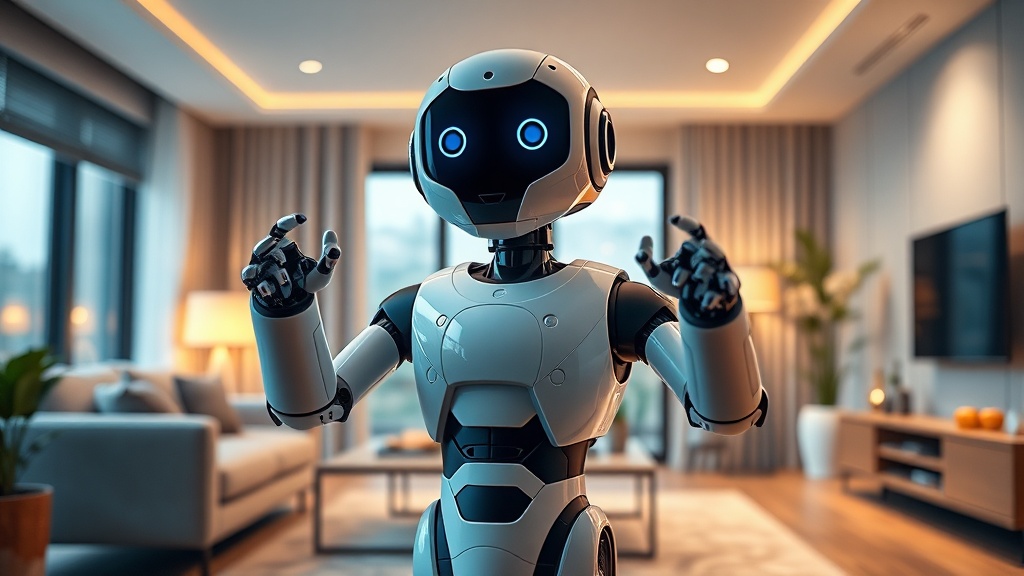
The SwitchBot Onero H1 stands approximately 1.3 meters tall, which puts its head at roughly counter height in most kitchens. It has a humanoid upper body with two articulated arms, a head with an expressive display face, and a wheeled base rather than legs. This is a deliberate design choice. Bipedal locomotion is still unreliable at the consumer price point, and wheels allow for smooth, predictable movement on flat surfaces.
The arms are the star of the hardware. Each arm has multiple joints providing a combined 22 degrees of freedom across the entire system. The hands feature gripper-style manipulators rather than individual fingers. They can grasp objects up to roughly two kilograms, which covers the vast majority of household items: remote controls, cups, books, bottles, small containers, laundry items, and similar objects.
Build quality is solid for a first-generation consumer robot. The shell is a matte white plastic that feels durable without being heavy. The joints move smoothly and quietly, though you can hear a faint servo whine when the arms are performing complex manipulations. The wheeled base is stable and has not tipped over once during our two weeks of testing, even on slightly uneven surfaces near doorway transitions.
The head features a small display that shows simple animated expressions. When the H1 is listening, it tilts its head slightly and displays attentive eyes. When it completes a task, it shows a brief smile animation. This sounds trivial, but it makes a meaningful difference in how people interact with the robot. Every visitor to our office during the testing period engaged with the H1 naturally, speaking to it conversationally rather than issuing commands. The design team at SwitchBot clearly studied how humans respond to anthropomorphic cues.
The overall aesthetic is friendly and minimal. It looks like something from a Pixar film rather than a Terminator sequel, which is exactly the right design choice for a device intended to share living spaces with families.
What It Can Actually Do
SwitchBot's marketing shows the H1 serving coffee, washing dishes, folding laundry, and organizing shelves. We need to be honest about the gap between marketing demonstrations and real-world performance.
Object Manipulation
This is where the H1 genuinely impresses. In our testing, the robot successfully picked up and relocated a wide variety of household objects: TV remotes, water bottles, coffee mugs (empty and partially filled), books, shoes, small boxes, and folded towels. The success rate with familiar objects was roughly 85 percent after the AI had time to learn our test environment. The remaining 15 percent of failures were typically objects that were too thin to grasp reliably (like a single sheet of paper) or too irregularly shaped for the gripper mechanism.
We gave the H1 a simple task: clear the coffee table of scattered items and place them on a nearby shelf. After training the robot on where items belonged, it completed this task consistently with only occasional fumbles. The process was slow, taking about three minutes to relocate five objects, but it worked.
Tidying and Organizing
The H1 can be trained to recognize where specific categories of objects belong. Over the course of a week, we taught it that shoes go near the front door, remote controls go on the TV stand, and water bottles go to the kitchen counter. Once trained, the robot could autonomously patrol a room and return displaced items to their designated locations.
This is genuinely useful. In a household with children or in a shared living space where common items migrate constantly, having a robot that periodically tidies up has real value. The execution is slow but reliable.
Laundry Assistance
SwitchBot demonstrates the H1 folding laundry in promotional videos. In our experience, the reality is more modest. The H1 can move laundry from a basket to a flat surface and make rudimentary folding motions with small items like t-shirts and towels. The results are not what you would call neatly folded. They are more like roughly organized into rectangular shapes. For larger items like jeans or sheets, the H1 struggled significantly and often gave up after multiple attempts.
We would not describe the H1 as a laundry-folding robot in its current state. It can assist with laundry handling, but it is not replacing the task.
Kitchen Tasks
The H1 can carry items between surfaces, which makes it useful as a kitchen helper in a limited sense. It can bring you a cup from a shelf or carry a plate from the counter to the table. It cannot cook, load a dishwasher effectively, or handle hot items safely. These are tasks that remain well beyond the capabilities of any consumer robot in 2026.
OmniSense AI in Practice
The brain of the H1 is SwitchBot's OmniSense VLA (Vision-Language-Action) AI model, and it is the most interesting part of the entire product. OmniSense processes visual, depth, and tactile sensor data simultaneously to understand the environment and make decisions about how to interact with objects.
Learning Your Home
During the initial setup, the H1 maps your home by wheeling through each room while its sensors build a 3D model of the space. This takes about fifteen minutes for a typical apartment. Over the following days, OmniSense continues to refine its understanding of the environment, learning where furniture sits, where objects tend to accumulate, and which paths are most efficient to travel.
After the first week, the H1's navigation was noticeably smoother than on day one. It anticipated obstacles, chose more efficient routes, and was less hesitant at doorways and tight spaces. The learning is real and measurable.
Object Recognition
OmniSense can identify common household objects without manual training. It recognized cups, bottles, remotes, books, shoes, and similar items from the start. For less common objects or items you want categorized in specific ways, you can train the AI by showing it the object and assigning a label through the app.
The recognition works well in good lighting and struggles in dim conditions. We noticed a significant drop in recognition accuracy when testing in a room with only a single table lamp. The H1 has onboard lighting that it uses when approaching objects in low light, but it is not sufficient for reliable recognition in dark environments.
Task Planning
When given a complex instruction like "clean up the living room," OmniSense breaks the task into subtasks: identify displaced objects, determine where each belongs, plan a route to efficiently collect and return them, and execute. We could watch this planning process in real time through the app, which displays the robot's understanding of the room and its planned actions.
The planning is impressive but not flawless. Occasionally, the H1 would plan a route that took it through a narrow gap it could not actually navigate, requiring a restart. Other times, it would attempt to pick up an object from an angle that made grasping impossible, fail, and then try the exact same approach again before eventually adjusting.
Occasional AI Confusion
We need to note that the AI does get confused. During our testing, the H1 once attempted to pick up a decorative plant, pulled it out of its pot, and then seemed unsure what to do with the loose soil. On another occasion, it identified a sleeping cat as a displaced object and slowly approached it with extended grippers before we intervened. These moments are rare but memorable, and they underscore that the AI is still in an early stage of development.
SwitchBot has been pushing frequent OTA updates throughout our testing period, and the AI did improve noticeably between the first and second weeks. This is a product that will get better over time, which matters when evaluating its current limitations.
Smart Home Integration
The H1 integrates with SwitchBot's existing smart home ecosystem and supports Matter, which means it can work with Apple Home, Google Home, Amazon Alexa, and Samsung SmartThings. In practice, this integration manifests in several useful ways.
The robot can be included in smart home automations. For example, you can create a routine that triggers the H1 to do a tidying patrol when everyone leaves the house, detected by a combination of door sensors and phone geofencing. You can trigger the H1 to bring you a specific item when you issue a voice command through your smart speaker.
The H1 also communicates its status to your smart home system. If it encounters an obstacle it cannot navigate, it can trigger a notification. If it detects an unusual item on the floor (like a spill or debris), it can alert you through the SwitchBot app and, via Matter, through other smart home platforms.
SwitchBot's own ecosystem integration is deeper. The H1 works with SwitchBot curtain motors, locks, sensors, and cameras to create more complex automations. For instance, the robot can be triggered to check on a room when a motion sensor detects activity at an unusual hour, acting as a mobile camera platform in addition to its manipulation capabilities.
Limitations
We believe in being straightforward about the H1's limitations because the marketing can create expectations that the current hardware and software cannot meet.
Speed
The H1 moves slowly. Its maximum speed is roughly walking pace, and when performing tasks, it moves even more deliberately. Clearing a coffee table of five items takes three to four minutes. A full room tidying session can take fifteen to twenty minutes. If you are in a hurry, you will always be faster doing the task yourself.
Stairs and Uneven Surfaces
The wheeled base cannot handle stairs, thick carpets, or significantly uneven surfaces. In a multi-story home, the H1 is limited to the floor where it is placed. Doorway thresholds and transitions between hard flooring and thin rugs are manageable, but deep-pile carpet reduces mobility significantly.
Task Range
The list of tasks the H1 can perform today is shorter than what the marketing suggests. It can pick up and relocate objects, do basic tidying, carry items between surfaces, and serve as a mobile camera. It cannot clean surfaces, operate appliances, handle delicate objects reliably, or perform the kind of complex kitchen and laundry tasks shown in demonstration videos.
Noise
The H1 is not loud, but it is not silent. Servo motors produce a consistent low whine during movement and manipulation. In a quiet room, the sound is noticeable. It would be distracting if operating in a bedroom while someone is sleeping.
Battery Life
The H1 runs for approximately three hours of active use on a full charge, or about eight hours in standby mode with occasional movement. It returns to its charging dock automatically when the battery drops below 15 percent. For most use cases, the battery life is adequate, but heavy-use days may require a midday charge.
Price and Value
The SwitchBot Onero H1 is expected to retail at approximately $1,500 when it becomes widely available. Beta units are being distributed to early testers in mid-2026, with general availability likely in late 2026.
At $1,500, the H1 is expensive for what it does today. A robot vacuum covers the cleaning use case more effectively for a third of the price. Smart home automations using sensors, plugs, and speakers handle most convenience tasks without a physical robot. The H1's unique value proposition, physical object manipulation, is impressive but limited in scope.
The value argument depends on your perspective. If you view the H1 as a first-generation product in a category that will improve dramatically over the next two to three years, with regular software updates expanding capabilities, $1,500 is a reasonable early-adopter premium. SwitchBot has a track record of long-term software support for its products, and the OmniSense AI is designed to improve through updates.
If you are looking for immediate, practical return on investment, the H1 is harder to justify. The tasks it handles today are tasks most people can do themselves in less time.
Buy SwitchBot Onero H1 on Amazon
Who Is This For?
The SwitchBot Onero H1 makes the most sense for a few specific audiences.
Tech Enthusiasts and Early Adopters. If you are the kind of person who bought the first Roomba, the first smart speaker, or the first VR headset, the H1 is the next frontier. It is the most capable consumer home robot available, and living with it provides a genuine glimpse of where the smart home is heading.
People With Mobility Challenges. For individuals who have difficulty bending down, reaching shelves, or moving around their home easily, the H1 offers real practical value. Having a robot that can fetch items, tidy surfaces, and carry objects between rooms addresses genuine accessibility needs.
Smart Home Power Users. If you already have an extensive smart home setup and want to add a physical automation layer, the H1's Matter integration and SwitchBot ecosystem compatibility make it a natural addition.
Families With Young Children. Homes with small children generate a constant stream of displaced objects. The H1's tidying capabilities, while slow, provide ongoing value in these environments.
Verdict
The SwitchBot Onero H1 is a remarkable achievement in consumer robotics. Its object manipulation capabilities are genuinely impressive, the OmniSense AI shows real potential to improve over time, and the friendly design makes it a natural presence in a home rather than an intrusion.
But it is a first-generation product, and it carries the typical first-generation tradeoffs. The task range is narrower than the marketing suggests. The speed is slow. The price is high relative to the practical value delivered today.
We scored the H1 a 7.5 out of 10. The technology is impressive and the potential is enormous, but the gap between what it can do and what most people need remains significant. If SwitchBot continues to improve the OmniSense AI through software updates, the H1 could become a very different product in twelve months. Whether that potential is worth $1,500 today is a question only you can answer.
For early adopters and those with specific accessibility needs, the H1 is a compelling purchase. For everyone else, it is a fascinating product to watch as it matures.
What We Liked
- Genuinely impressive object manipulation for a consumer robot
- Friendly, approachable design that does not intimidate
- OmniSense AI learns your home layout and adapts over time
- Matter compatible for broad smart home integration
What Could Improve
- Expensive for what it currently does
- Slow movement speed limits practical usefulness
- Limited task range compared to marketing promises
- Occasional AI confusion with unfamiliar objects
The Verdict
The SwitchBot Onero H1 is the most capable consumer home robot we have tested. Its object manipulation is genuinely impressive, the OmniSense AI shows real promise, and the design is approachable rather than intimidating. But at this price, the gap between what it can do and what you need it to do is still wide. This is a first-generation product that points toward an exciting future while asking early adopters to pay a premium for the privilege of getting there first.
Was this article helpful?
Join the conversation — sign in to leave a comment and engage with other readers.
Loading comments...
Related Posts
smart-home
Eufy Video Doorbell S4 Review: AI Tracking Without the Subscription
Apr 13, 2026smart-home
Aqara U400 Smart Lock Review: Ultra-Wideband Unlocking Changes Everything
Apr 4, 2026smart-home
Alexa Plus vs Google Home AI 2026: Which Smart Assistant Actually Wins?
Apr 13, 2026smart-home
Smart Homes in 2026: How Matter, AI, and Green Tech Are Reshaping Everyday Living
Apr 4, 2026Enjoyed this article?
Get the best tech reviews, deals, and deep dives delivered to your inbox every week.