NewsAi5 min read
OpenAI Launches GPT-5.5: ChatGPT Becomes an Agent, Not a Chatbot
OpenAI shipped GPT-5.5 on April 23, 2026 — pitched less as a chat upgrade and more as an agent runtime built to take actions, hold long task state, and run multi-step workflows. Here's what's new, what it costs, and whether normal users should upgrade.
Omer YLD
Founder & Editor-in-Chief
5 min · 1,100 words
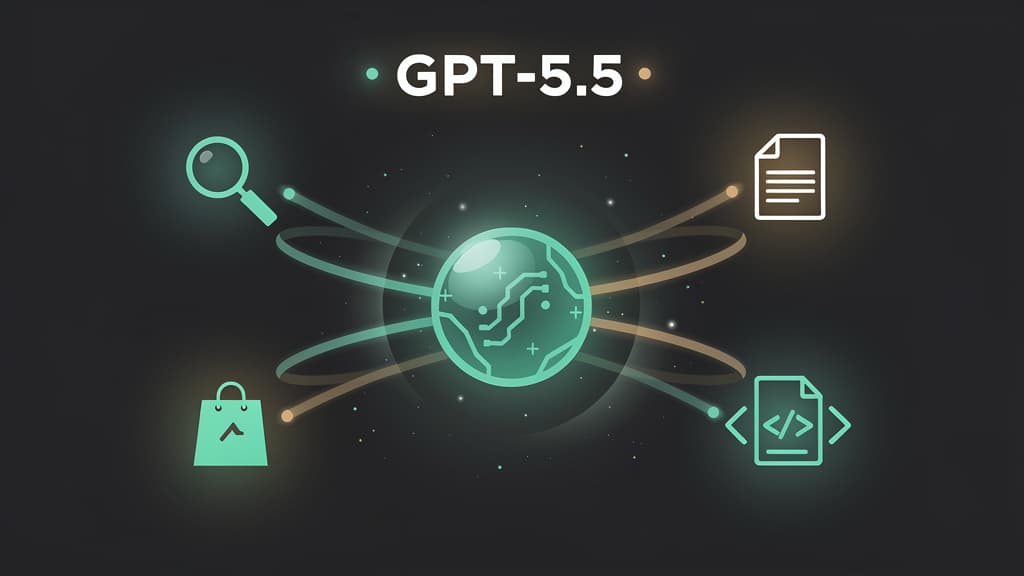
Illustration · Technerdo
OpenAI launched GPT-5.5 on April 23, 2026, and the framing from Sam Altman's team is unusually direct: this isn't a smarter chatbot — it's an agent. GPT-5.5 is built to take multi-step actions, hold longer task state across a session, and chain tool calls without losing the plot, with TechCrunch reporting the model rolled out the same day to ChatGPT Plus, Pro, Business, and Enterprise tiers.
Alongside the model, OpenAI shipped three product features that lean hard on the agent framing — a File Library that gives ChatGPT persistent file context across chats, a beefed-up Shopping experience with side-by-side product comparison, and Images 2.0 with 2K-resolution output. Pricing has shifted up: standard GPT-5.5 is now $5 per million input tokens / $30 per million output tokens via API, and the Pro tier (Plus+ subscribers and developers) is $30 / $180 per million.
What "agent ChatGPT" actually means
The headline shift in GPT-5.5 isn't IQ — it's autonomy. Previous GPT versions chained tool calls fine, but lost coherence on tasks that ran longer than a few minutes. GPT-5.5 is explicitly trained on long-horizon tasks: research projects that require pulling 20+ pages and stitching them into a brief, shopping searches that compare products across half a dozen retailers, multi-file coding tasks that span a working session.
OpenAI's launch demos showed three workflows that previous ChatGPT versions consistently failed at:
- Research → write. Plan a trip from scratch (flights + hotels + activities) given budget and dates, then output a complete itinerary as a downloadable PDF.
- Shopping → compare → buy. Find a TV under $1,200 with the best HDR performance for daytime viewing, side-by-side compare the three finalists, deep-link to a checkout page.
- Code → ship. Refactor a multi-file repo against a stated requirement, run the tests, and open a pull request — all from a single instruction.
The pitch isn't that GPT-5.5 can do these (older versions could, with a lot of hand-holding), but that it does them without the user needing to nudge it back on task every two minutes. In practice, that's the difference between a tool you supervise and a tool you delegate to.
What ships alongside the model
File Library
Every ChatGPT user now has a File Library — a persistent, searchable file area attached to your account. Drop a PDF or spreadsheet in once, and any future chat can reference it. Critically, the agent can pull from the library proactively ("Find the Q3 report I uploaded last week and pull the revenue numbers") instead of you re-uploading per session. This is the feature most likely to matter to professional users — it ends the "where did I put that PDF" tax that's plagued ChatGPT since launch.
Shopping (with real comparison)
ChatGPT Shopping has existed in some form since 2025, but until now it was essentially a chat-with-affiliate-links experience. GPT-5.5's Shopping mode does side-by-side comparison with structured product cards, deep-links into retailer checkout, and price-history context. OpenAI hasn't published the merchant list, but launch coverage notes Amazon, Best Buy, Walmart, and Target are integrated. For practical buyers this is the first time ChatGPT does what Google Shopping promised in 2012.
Images 2.0 at 2K
GPT-5.5's image model now outputs at 2048×2048 for square / 2K-equivalent dimensions for landscape and portrait — a meaningful jump from the 1024×1024 default. Images 2.0 is also better at the perennial weak point of generative imagery: text inside the image. Posters, simple infographics, and product mocks come out with legible labels on the first generation in OpenAI's launch examples, though our own testing this week found mixed results once you push beyond 4–5 words.
Pricing — and who should pay for it
The price tiers shifted upward:
| Tier | Where you get it | Cost |
|---|---|---|
| GPT-5.5 (standard) | ChatGPT Plus ($20/mo), Business, Enterprise; API at $5/$30 | Included in Plus |
| GPT-5.5 Pro | ChatGPT Pro ($200/mo) and Plus+ tier; API at $30/$180 | $200/mo or higher |
The Plus → Pro gap is now meaningful in a way it wasn't with GPT-5. If you write code, do long research sessions, or run agent-style workflows that touch lots of tools, GPT-5.5 Pro makes the $200/mo tier defensible for the first time. For everyone else — chat, drafting, occasional analysis — the standard GPT-5.5 inside Plus is enough.
How it compares to Claude and Gemini
The competitive picture in late April 2026: Anthropic's Claude Opus 4.7 (covered in our recent comparison) holds the lead on coding and long-context reasoning, with the 1M-token context window still ahead of GPT-5.5's stated 400K. Google's Gemini 3.1 Pro leads on multimodal video understanding and remains the cheapest of the three serious frontier models. GPT-5.5's positioning is the agent middle — not the smartest single response, but the most reliable autonomous task executor.
The interesting question is whether agent reliability becomes the new battleground. Anthropic shipped Claude's Agent Skills system earlier this year, Google has Gemini Agents in beta, and now OpenAI has gone all-in on the framing. Within six months, "is the model smart" matters less than "does the agent finish without me babysitting it."
What's next
OpenAI hasn't dated GPT-6 or anything past 5.5, but the company's research roadmap (per Altman's recent comments) suggests the focus through the rest of 2026 will be agent reliability — long-running tasks, persistent memory, and tool integrations — rather than another raw-capability jump. GPT-5.5 Mini and a faster GPT-5.5 Flash variant for the API are expected within weeks, based on OpenAI's prior cadence.
For consumers, the practical move is: try GPT-5.5 for two or three real tasks — a research project you'd otherwise punt to a paid analyst, a shopping decision you'd usually thrash through across 12 tabs, a multi-file coding refactor — and see whether the autonomy holds up for your workflows. The marketing demos are clean. The real test is whether your edge cases break it.
If you've been holding off upgrading because GPT-5 felt incremental, GPT-5.5 is the first OpenAI release in a year that genuinely changes what the product is. Whether it changes what you'd pay for it depends entirely on how much of your week is spent supervising AI instead of just talking to it.
Was this piece worth your five minutes?
Join the conversation — sign in to leave a comment and engage with other readers.
Loading comments...