NewsAi5 min read
Tim Cook Is Stepping Down — John Ternus Becomes Apple CEO September 1
Apple confirmed on April 20, 2026 that Tim Cook will become executive chairman and hardware chief John Ternus will become CEO effective September 1. Here's who Ternus is, what changes for Apple's product strategy, and what it means for buyers.
Omer YLD
Founder & Editor-in-Chief
5 min · 1,050 words
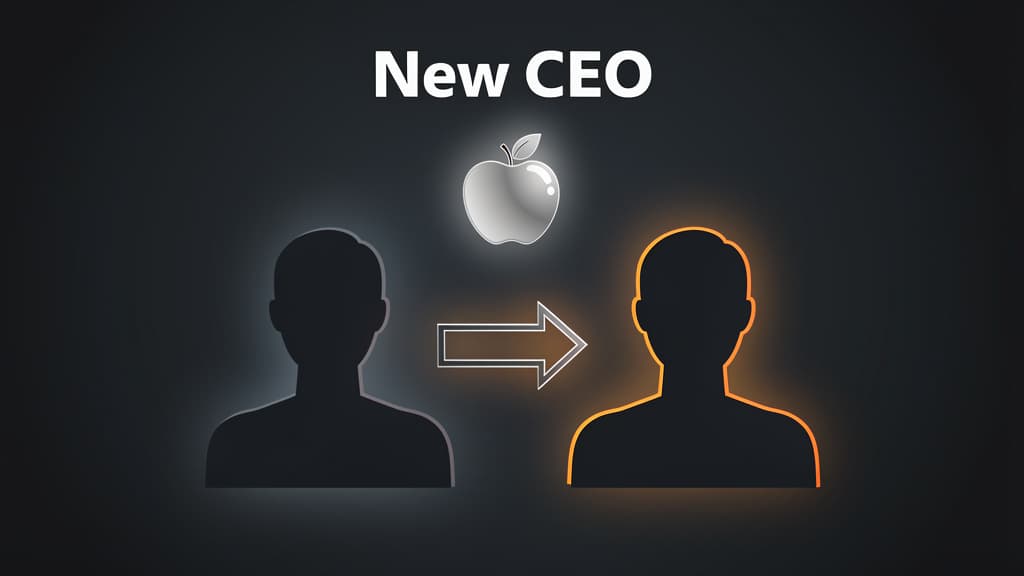
Illustration · Technerdo
Apple officially confirmed on April 20, 2026 what insider reporting had been telegraphing for months: Tim Cook is stepping down as CEO. He'll move to the role of executive chairman effective September 1, 2026, and John Ternus, currently senior vice president of Hardware Engineering, will become Apple's chief executive officer. The transition was corroborated by Fortune, 9to5Mac, and CNBC, and forms the first CEO transition at Apple since Cook himself succeeded Steve Jobs in 2011.
The succession is friendly and well-telegraphed — no boardroom drama, no unexpected exit. But it's also genuinely consequential. Cook spent 14 years scaling Apple from a hit-product company into a $4 trillion services-and-hardware platform. Ternus inherits Apple at the front edge of an AI transition, a foldable iPhone launch, and the most ambitious product-category expansion since the Apple Watch.
Who is John Ternus?
If you bought any Apple hardware product in the past decade, John Ternus has been quietly running the team that built it. Ternus joined Apple in 2001 fresh out of the University of Pennsylvania (mechanical engineering degree, former competitive swimmer), and rose through the hardware engineering ranks under the Mike Mankowski / Dan Riccio era. When Riccio stepped back from day-to-day hardware leadership in 2021 to focus on Vision Pro, Ternus inherited the broader hardware engineering portfolio.
His public profile has been low — he hosted segments at WWDC and Apple events, but never sought visibility the way Phil Schiller, Craig Federighi, or Eddy Cue have. The internal reputation is well-documented in coverage from Bloomberg and Fortune: respected as a hands-on engineer, decisive, willing to kill projects that aren't working, well-liked across the executive bench.
In a recent CNBC profile, Ternus acknowledged that early in his Apple tenure he doubted he belonged. The arc from there to here — engineer-turned-CEO of the world's most valuable company — fits Apple's preferred succession pattern: deeply technical, internally promoted, no outside import.
What changes — and what doesn't
The honest answer is that not much changes immediately, by design. Apple's CEO transitions are deliberately undramatic:
What stays the same
- Product roadmap through 2027 — locked. The foldable iPhone (September 2026), the smart-home push, the AI/Siri-on-Gemini integration, Vision Pro 2 — all set under Cook's tenure and continuing.
- Services strategy — Eddy Cue continues to run Services, which has grown into Apple's second-largest revenue line. No expected change.
- Software direction — Craig Federighi continues running software engineering, and the AI integration strategy he's championed (on-device AI plus Private Cloud Compute) remains the architecture.
- Financial discipline — Luca Maestri remains CFO. Apple's capital-return programs continue.
What may shift
- Hardware ambition. Ternus is a hardware-first executive in a way Cook (operations background) wasn't. The "six new product categories" reporting from Mark Gurman last week — covered in our Apple 2026 product roadmap — fits the profile of a CEO with a hardware operator's instincts. Expect more swing-for-the-fences hardware, less risk aversion.
- Vision Pro and emerging-category resourcing. Vision Pro has had a slower commercial start than Apple's earlier wearables. Ternus, who shepherded Vision Pro engineering, is unlikely to lose patience with the category — but he may be more decisive about pivoting if a particular form factor isn't working.
- AI partnerships. Apple's pragmatic decision to use Google's Gemini as one of the underlying models for the new Siri (running on Apple's Private Cloud Compute infrastructure, no data shared with Google) is an interesting departure from Apple's historical preference for full vertical integration. Ternus's instincts on partnerships versus building-internal will matter through the rest of the decade.
- Public posture on policy and geopolitics. Cook is taking on the executive chairman role explicitly to handle global policymaker engagement. That's a deliberate division of labor — Ternus runs the company, Cook runs the political relationship management. It tells you something about which conversations a hardware engineer wants to delegate.
What it means for buyers
If you're an Apple customer:
- Nothing in the 2026 product lineup changes. What Apple ships through fall 2026 — the next iPhones (including the foldable), the M5 Macs, the smart-home refresh — was already in deep development under Cook's tenure.
- The 2027 lineup is the first under Ternus's full direction. Watch what gets greenlit and what gets quietly shelved between now and then. Hardware-engineer CEOs tend to ship the things they're personally excited about and kill the things they aren't.
- Service pricing and ecosystem lock-in are unlikely to change quickly. Cook's services strategy was successful financially and there's no indication Ternus disagrees with it.
If you cover Apple as an investor, the analyst consensus on day one was muted — modest stock dip, recovered the same week, no broad re-rating. That's exactly the reaction Apple's board wanted: a transition handled well enough that markets don't think it's news.
What's next
Three things to watch over the rest of 2026:
- The September 1 handover itself. Watch for the standard public moves — Ternus on the WWDC stage in larger roles, public statements at the iPhone event, eventual sit-down interviews.
- The 2027 budget and roadmap signals. Apple doesn't publicly disclose internal budgets, but you can read direction from product launches and discontinuations. The first products that ship in fall 2027 will tell you what Ternus's Apple actually values.
- The AI strategy. Apple's AI position is the most interesting open question across all of consumer tech in 2026. Ternus's hardware orientation may push Apple toward more aggressive on-device silicon for AI workloads, or toward deeper partnership with cloud-AI providers. Both have implications for what your iPhone can do without a network connection in 2027.
For now, the practical reality is unchanged. Apple ships what Apple was already going to ship. The interesting story is the one that starts on September 2.
Was this piece worth your five minutes?
Join the conversation — sign in to leave a comment and engage with other readers.
Loading comments...